missing translation for 'onlineSavingsMsg'
Learn More

Gibco™ Human/Mouse/Rat BMP-2 Recombinant Protein, PeproTech®

Código de producto. 17851743
Click to view available options
Cantidad:
100 μg
10 μg
1 mg
250 μg
2 μg
500 μg
50 μg
Tamaño de la unidad:
1 miligramo
10 microgramos
100 microgramos
2 microgramos
250 microgramos
50 microgramos
500 microgramos
Este artículo no se puede devolver. Vea la política de devoluciones

Código de producto. 17851743

Marca: Gibco™ 12002C1MG

Por favor, para comprar este producto. ¿No tiene usuario web? Regístrese hoy mismo.

Este artículo no se puede devolver. Vea la política de devoluciones

Recombinant Protein

Recombinant Human/Murine/Rat BMP-2 derived from CHO cells is a homodimeric glycoprotein that consists of two 114 amino acid polypeptide chains linked by a single disulfide bond. Due to glycosylation, CHO cell-derived Human/Murine/Rat BMP-2 migrates at an apparent molecular weight of approximately 28-29 kDa by SDS-PAGE analysis under non-reducing conditions. This product is shipped at ambient temperature. For storage, handling and reconstitution information, please see the lot-specific Certificate of Analysis

Bone Morphogenic Proteins (BMP) are members of the TGF-beta superfamily that affect bone and cartilage formation (Hogan 1996, Reddi 1998 and Francis-West et al. 1999). Mature BMPs are 30-38 kDa proteins that assume a TGF-beta -like cysteine knot configuration. Lovostatin increases bone formation by turning on the bmp-2 gene (Mundy et al. 1999). BMPs stimulate the production of specific bone matrix proteins and alter stromal cell and osteoclast proliferation (Macias et al. 1999, Lecanda et al. 1997). BMPs may also be an important factor for development of the viscera, with roles in cell proliferation, apoptosis, differentiation, and morphogenesis (Hogan 1996, Dale and Wardle 1999). BMPs appear to be responsible for normal dorsal/ventral patterning. Like TGF-beta, BMPs bind to a type II receptor, which then recruits the transducing type I receptor unit, activating the Smad protein signaling pathway (Massague 1994, Derynck 1997, Attisano 1993).
TRUSTED_SUSTAINABILITY

Especificaciones

Número de acceso P12643, P21274, P49001
Para utilizar con (aplicación) Functional Assay
Formulación protein with no preservative
ID de gen (Entrez) 12156, 29373, 650
Peso molecular 25.8 kDa
Nombre Human/Mouse/Rat BMP-2
Cantidad 1 mg
Fuente CHO cells
Estado normativo RUO
Concentración de endotoxinas <1 EU/ μg
Alias de gen 2610024H22Rik; AI467020; AL117858; AW546137; BB189135; BDA2; BMP; BMP2; BMP-2; BMP2A; BMP-2 A; BMPRII; BMPR-II; Bone morphogenetic protein; Bone morphogenetic protein 2; bone morphogenetic protein 2 precursor (BMP-2) (BMP-2 A); bone morphogenetic protein 2 A; H-BMP-2; morphogen
Nombre común BMP-2
Símbolo de gen BMP2
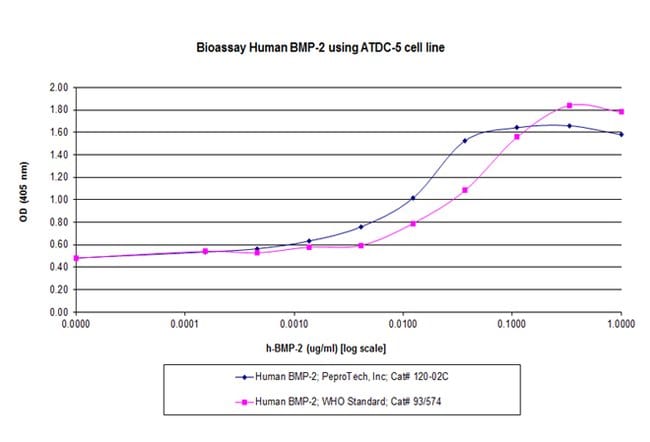
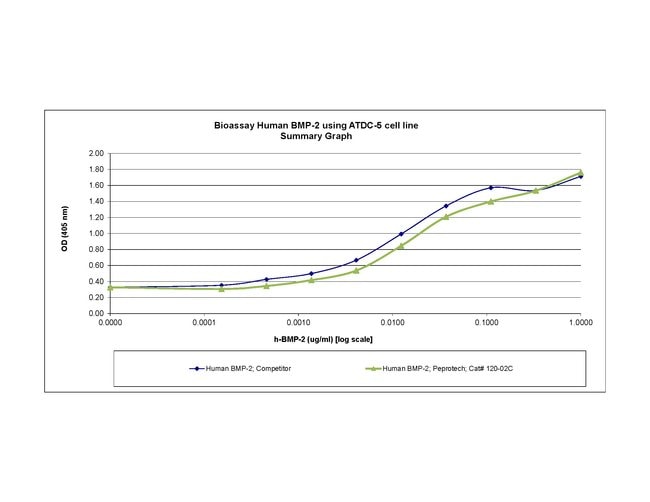
Actividad biológica Determined by its ability to induce alkaline phosphatase production by ATDC-5 cells. The expected ED50 for this effect is 40-100 ng/ml
Conjugado Unconjugated
Recombinante Recombinant
Secuencia QAKHKQRKRL KSSCKRHPLY VDFSDVGWND WIVAPPGYHA FYCHGECPFP LADHLNSTNH AIVQTLVNSV NSKIPKACCV PTELSAISML YLDENEKVVL KNYQDMVVEG CGCR
Contenido y almacenamiento -20°C
Sistema de expresión CHO cells
Formulario Lyophilized
Grado de pureza o calidad ≥ 95% by SDS-PAGE gel and HPLC analyses.
Mostrar más Mostrar menos
Corrección del contenido de un producto

Proporcione sus comentarios sobre el contenido del producto rellenando el siguiente formulario.

Título del producto

Al hacer clic en Enviar, acepta que Fisher Scientific se ponga en contacto con usted en relación con los comentarios que ha proporcionado en este formulario. No compartiremos su información para ningún otro fin. Toda la información de contacto proporcionada se mantendrá de acuerdo con nuestra Política de Privacidad. Política de privacidad.

Gracias por ayudarnos a mejorar nuestra web. Su comentario ha sido enviado