missing translation for 'onlineSavingsMsg'
Learn More
Learn More
Invitrogen™ RIP3 Polyclonal Antibody

Descripción
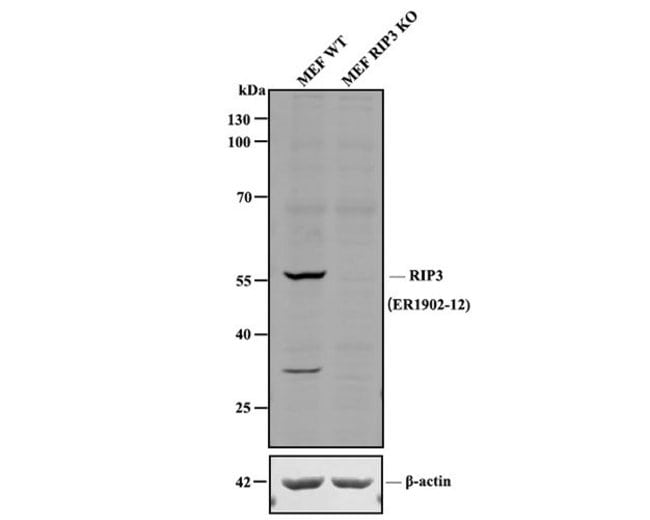
Positive Control: MEF cell lysates. Subcellular Location: Mitochondrion, Cytosol, Plasma membrane.
RIPK3 is a member of the receptor-interacting protein (RIP) family of serine/threonine protein kinases, which contains a C-terminal domain unique from other RIP family members. RIPK3 is predominantly localized to the cytoplasm, and specifically, are colocalized in the mitochondrion which can undergo nucleocytoplasmic shuttling dependent on novel nuclear localization and export signals. RIPK3 is a component of the tumor necrosis factor (TNF) receptor-I signaling complex, and can induce apoptosis and weakly activate the NF-kappaB transcription factor and caspase-8 prevents RIPK3-dependent necrosis without inducing apoptosis by functioning in a proteolytically active complex with CFLAR and that this complex is required for the protective function.

Especificaciones
Especificaciones
| Antígeno | RIP3 |
| Aplicaciones | Western Blot |
| Clasificación | Polyclonal |
| Concentración | 1 mg/mL |
| Conjugado | Unconjugated |
| Formulación | PBS with 0.2% BSA, 50% glycerol and 0.05% sodium azide; pH 7.4 |
| génica | RIPK3 |
| N.º de referencia del gen | Q9QZL0, Q9Z2P5 |
| Alias de gen | 2610528K09Rik; AW107945; Hcyp2; Homocysteine respondent protein HCYP2; mRIP3; receptor interacting protein 3; receptor interacting serine/threonine kinase 3; receptor-interacting protein 3; receptor-interacting serine/threonine-protein kinase 3; receptor-interacting serine-threonine kinase 3; Rip3; RIP-3; Ripk3; RIP-like protein kinase 3 |
| Símbolos de los genes | RIPK3 |
| Mostrar más |
Título del producto
Al hacer clic en Enviar, acepta que Fisher Scientific se ponga en contacto con usted en relación con los comentarios que ha proporcionado en este formulario. No compartiremos su información para ningún otro fin. Toda la información de contacto proporcionada se mantendrá de acuerdo con nuestra Política de Privacidad. Política de privacidad.
¿Detecta una oportunidad de mejora?