Learn More
PeproTech RANKL (soluble) Polyclonal Antibody, PeproTech®, Invitrogen™
Descripción
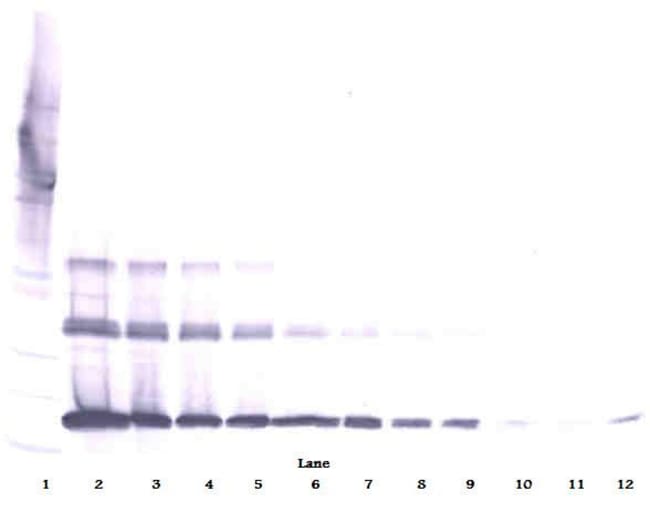
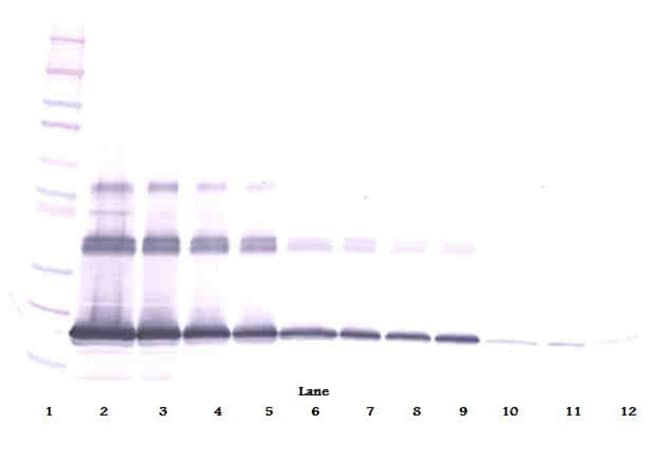
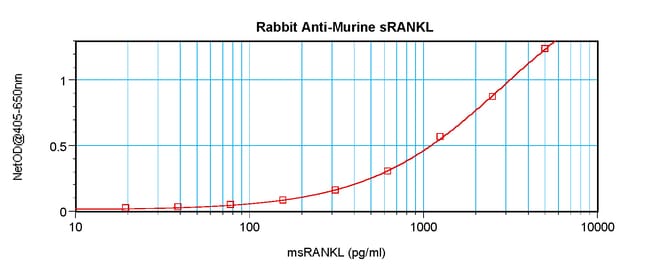
AA Sequence of recombinant protein: PAMMEGSWLD VAQRGKPEAQ PFAHLTINAA SIPSGSHKVT LSSWYHDRGW AKISNMTLSN GKLRVNQDGF YYLYANICFR HHETSGSVPT DYLQLMVYVV KTSIKIPSSH NLMKGGSTKN WSGNSEFHFY SINVGGFFKL RAGEEISIQV SNPSLLDPDQ DATYFGAFKV QDID. Preparation: Produced from sera of rabbits immunized with highly pure Recombinant Murine sRANK Ligand. Anti-Murine sRANK Ligand-specific antibody was purified by affinity chromatography employing an immobilized Murine sRANK Ligand matrix. Sandwich ELISA: To detect Murine sRANK Ligand by sandwich ELISA (using 100 μL/well antibody solution) a concentration of 0.5-2.0 μg/mL of this antibody is required. This antigen affinity purified antibody, in conjunction with PeproTech Biotinylated Anti-Murine sRANKL (500-P63Bt) as a detection antibody, allows the detection of at least 0.2-0.4 ng/well of Recombinant Murine sRANK Ligand. Western Blot: To detect Murine sRANK Ligand by Western Blot analysis this antibody can be used at a concentration of 0.1-0.2 μg/mL. Used in conjunction with compatible secondary reagents the detection limit for Recombinant Murine sRANK Ligand is 1.5-3.0 ng/lane, under either reducing or non-reducing conditions.

Especificaciones
Especificaciones
| Antígeno | RANKL (soluble) |
| Aplicaciones | ELISA, Western Blot |
| Clasificación | Polyclonal |
| Concentración | 0.1-1.0 mg/mL |
| Conjugado | Unconjugated |
| Formulación | PBS with no preservative |
| génica | TNFSF11 |
| N.º de referencia del gen | O35235 |
| Alias de gen | CD254; H-RANK-L; hRANKL2; Ly109l; M-Rank-L; ODF; OPG; OPG ligand; OPGL; OPTB2; Osteoclast differentiation factor; osteoprotegerin ligand; Rankl; rank-l; receptor activator of NF-kappaB ligand; receptor activator of nuclear factor kappa B ligand; receptor activator of nuclear factor kappa-B ligand; RP11-86N24.2; sOdf; srankl; TNF-related activation-induced cytokine; Tnfsf11; TNLG6B; Trance; tumor necrosis factor (ligand) superfamily member 11; tumor necrosis factor (ligand) superfamily, member 11; tumor necrosis factor ligand 6B; tumor necrosis factor ligand superfamily member 11; Tumor necrosis factor ligand superfamily member 11, membrane form; Tumor necrosis factor ligand superfamily member 11, soluble form; tumor necrosis factor superfamily member 11; tumor necrosis factor-related activation-induced cytokine |
| Símbolos de los genes | TNFSF11 |
| Mostrar más |
Al hacer clic en Enviar, acepta que Fisher Scientific se ponga en contacto con usted en relación con los comentarios que ha proporcionado en este formulario. No compartiremos su información para ningún otro fin. Toda la información de contacto proporcionada se mantendrá de acuerdo con nuestra Política de Privacidad. Política de privacidad.