Learn More

Invitrogen™ Phospho-STAT1 (Tyr701) Monoclonal Antibody (ST1P-11A5)
Descripción
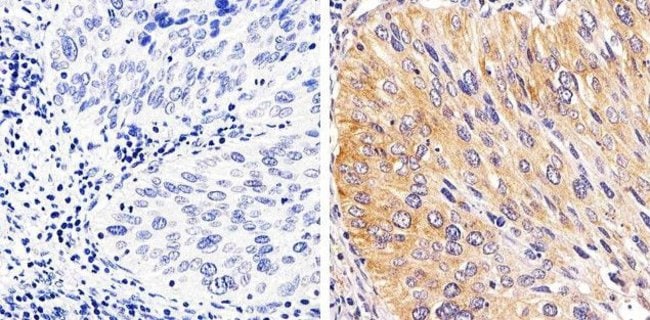
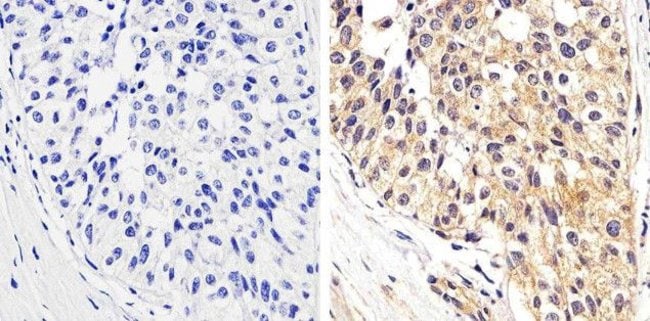
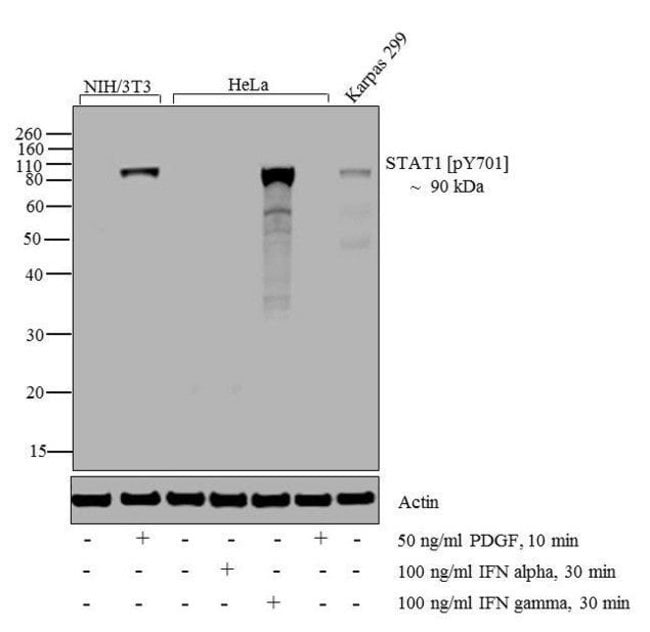
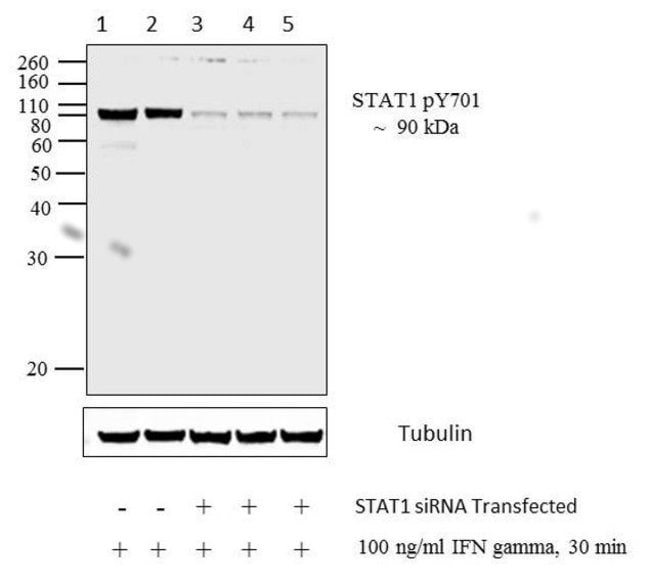
This antibody reacts specifically with the tyrosine-701 phosphorylated form of STAT1 and does not exhibit appreciable cross-reactivity with corresponding tyrosine phosphorylated forms of other STAT proteins or with other endogenous phosphotyrosine-containing proteins. To confirm the exclusive recognition of tyrosine phosphorylated STAT1, Western blots were carried out on lysates of 293 cells transfected with a STAT1 expression vector together with a wild type or kinase 'dead' JAK1 expression vector. In addition, recognition of endogenous tyrosine phosphorylated STAT1 was confirmed on Western blots with cell lysates derived from serum starved or EGF-stimulated A431 cells and on Western blots with IFNa-stimulated mouse embryo fibroblast lysates.

Especificaciones
Especificaciones
| Antígeno | Phospho-STAT1 (Tyr701) |
| Aplicaciones | ChIP Assay, ELISA, Immunohistochemistry (Paraffin), Western Blot |
| Clasificación | Monoclonal |
| Clon | ST1P-11A5 |
| Concentración | 0.5 mg/mL |
| Conjugado | Unconjugated |
| Formulación | PBS with 0.1% sodium azide; pH 7.4 |
| génica | STAT1 |
| N.º de referencia del gen | P42224, P42225 |
| Alias de gen | 2010005J02Rik; AA408197; CANDF7; DD6G4-4; DKFZp686B04100; IMD31A; IMD31B; IMD31C; ISGF-3; LOW QUALITY PROTEIN: signal transducer and activator of transcription 1-alpha/beta; OTTHUMP00000165046; OTTHUMP00000205845; signal transducer and activator of transcription 1; signal transducer and activator of transcription 1, 91kD; signal transducer and activator of transcription 1, 91kDa; signal transducer and activator of transcription 1-alpha/beta; signal transducer and activator of transcription-1; STAT; STAT 1; STAT1; STAT-1; stat1 alpha; STAT91; transcription factor ISGF-3; transcription factor ISGF-3 components p91/p84 |
| Mostrar más |
Al hacer clic en Enviar, acepta que Fisher Scientific se ponga en contacto con usted en relación con los comentarios que ha proporcionado en este formulario. No compartiremos su información para ningún otro fin. Toda la información de contacto proporcionada se mantendrá de acuerdo con nuestra Política de Privacidad. Política de privacidad.