missing translation for 'onlineSavingsMsg'
Learn More
Learn More
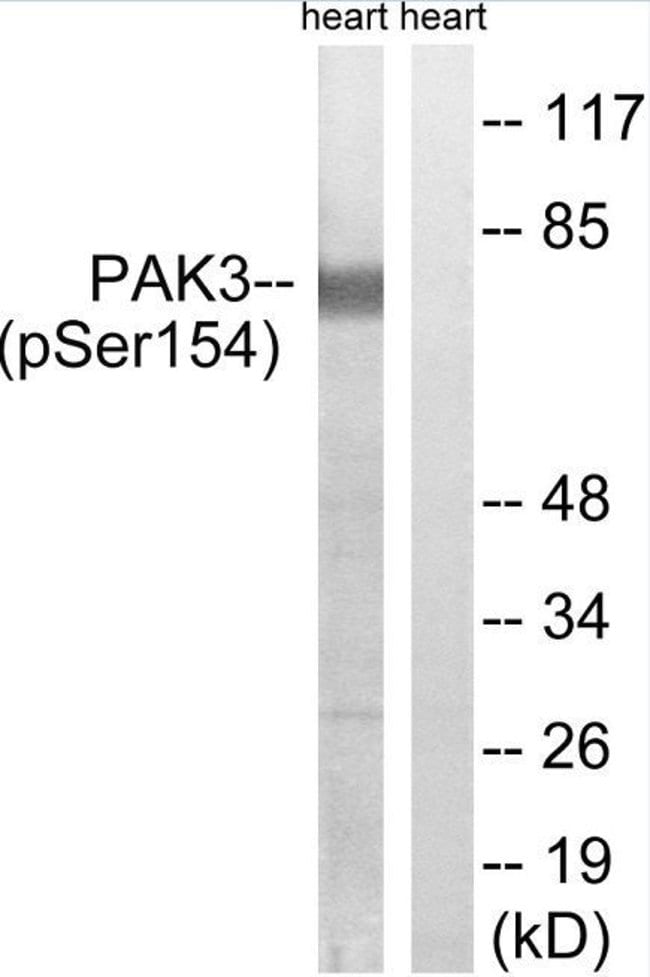
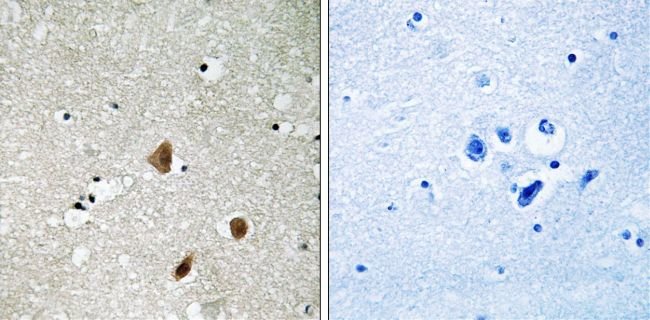
Phospho-PAK3 (Ser154) Polyclonal Antibody, Invitrogen™
Rabbit Polyclonal Antibody
Marca: Invitrogen PA538153
Este artículo no se puede devolver.
Vea la política de devoluciones
Descripción
Three isoforms of serine/threonine kinases, designated alphaPAK p68, betaPAK p65 and gammaPAK p62, have been shown to exhibit a high degree of sequence homology with the S. cerevisiae kinase Ste 20, involved in pheromone signaling. The alpha, beta and gammaPAK isoforms complex specifically with Rac1 and Cdc42 in their active GTP-bound state, inhibiting their intrinsic GTPase activity leading to their autophosphorylation. There are eight sites of autophosphorylation on gammaPAK, including Ser 19, Ser 141 and Thr 402, and phosphorylation of Ser 141 and Thr 402 is correlated with gammaPAK activation. Once phosphorylated and their affinity for Rac/Cdc42 reduced, the PAK isoforms disassociate from the complex to seek downstream substrates.
Especificaciones
| Phospho-PAK3 (Ser154) | |
| Polyclonal | |
| Unconjugated | |
| PAK3 | |
| Serine/threonine-protein kinase PAK 3, EC=2.7.11.1, Beta-PAK,Oligophrenin-3,p21-activated kinase 3, PAK3, OPHN3 | |
| Rabbit | |
| Antigen affinity chromatography | |
| RUO | |
| 18481, 29433, 5063 | |
| -20°C | |
| Liquid |
| Immunohistochemistry (Paraffin), Western Blot | |
| 1 mg/mL | |
| Dulbecco′s PBS with 150mM NaCl, 50% glycerol and 0.02% sodium azide; pH 7.4 | |
| O75914, Q61036, Q62829 | |
| PAK3 | |
| A synthetic phosphopeptide derived from human PAK3 around the phosphorylation site of Ser154 | |
| 100 μg | |
| Primary | |
| Human, Mouse, Rat | |
| Antibody | |
| IgG |
Corrección del contenido de un producto
Proporcione sus comentarios sobre el contenido del producto rellenando el siguiente formulario.
Título del producto
¿Detecta una oportunidad de mejora?Comparta una corrección de contenido