missing translation for 'onlineSavingsMsg'
Learn More

Invitrogen™ Occludin Monoclonal Antibody (OC-3F10), Alexa Fluor™ 488

Código de producto. 10073504
Change view
Click to view available options
Cantidad:
100 μg
Tamaño de la unidad:
cada uno
1 product options available for selection
Product selection table with 1 available options. Use arrow keys to navigate and Enter or Space to select.
Código de producto. Cantidad unitSize
10073504 100 μg cada uno
Use arrow keys to navigate between rows. Press Enter or Space to select a product option. 1 options available.
1 options
Este artículo no se puede devolver. Vea la política de devoluciones
Código de producto. 10073504 Proveedor Invitrogen™ N.º de proveedor 331588

Por favor, para comprar este producto. ¿No tiene usuario web? Regístrese hoy mismo.

Este artículo no se puede devolver. Vea la política de devoluciones

Mouse Monoclonal Antibody

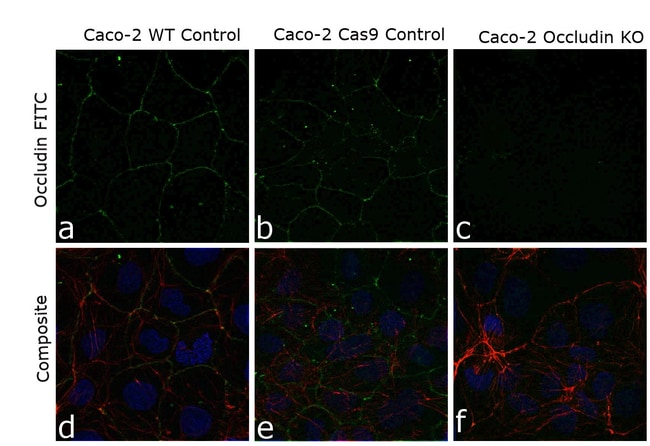
Reactivity of this antibody with the occludin protein has been confirmed by immunofluorescence and western blotting (unconjugated). This antibody reacts specifically with mammalian occludin. Tissues/lysates that were tested with this antibody include T84 cell line (human intestinal epithelium), MDCK cells (canine kidney), Caco-2 cells (human colon adenocarcinoma), MTE7B (Mouse), and rat liver.

Occludin is a 65 kDa protein that can exist in a variety of phosphorylated forms, ranging up to approximately 82 kDa. Occludin is thought to be involved in regulating both the localization and the function of occludin. Polyunsaturated fatty acids are known to up-regulate occludin expression, increasing the transendothelial cell resistance and reducing the cellular permeability to large molecules. The level of occludin varies greatly depending on tissue; in brain tissue, occludin is highly and continuously expressed at cell-cell contact sites, whereas non-neural tissues show lower expression and discontinuous distribution. Overall structural features of the occludin protein are highly conserved in all the species examined. Under-expression of tight junction proteins, including occludin, is a key molecular abnormality responsible for the increased permeability of tumor endothelial tight junctions, which contributes to brain tumor edemas.
TRUSTED_SUSTAINABILITY

Especificaciones

Antígeno Occludin
Aplicaciones ELISA, Western Blot, Immunocytochemistry
Clasificación Monoclonal
Clon OC-3F10
Concentración 0.5 mg/mL
Conjugado Alexa Fluor 488
Formulación PBS with 4.0mg/mL BSA and 0.1% sodium azide; pH 7.4
génica OCLN
N.º de referencia del gen Q16625, Q28269, Q61146, Q6P6T5
Alias de gen AI503564; BLCPMG; Occludin; occludin 1B; Ocl; Ocln; phosphatase 1, regulatory subunit 115; PPP1R115; tight junction protein occludin; tight junction structural protein
Símbolos de los genes OCLN
Especie del huésped Mouse
Inmunógeno GST-fusion protein consisting of the C-terminal region (~150 aa) of human occludin.
Método de purificación Protein A
Cantidad 100 μg
Estado normativo RUO
Primario o secundario Primary
ID de gen (Entrez) 100506658, 18260, 403844, 83497
Especies diana Human, Mouse, Rat, Canine
Contenido y almacenamiento 4°C, store in dark
Tipo de producto Antibody
Formulario Liquid
Isotype IgG1 κ
Mostrar más Mostrar menos
Título del producto
Seleccione un problema

Al hacer clic en Enviar, acepta que Fisher Scientific se ponga en contacto con usted en relación con los comentarios que ha proporcionado en este formulario. No compartiremos su información para ningún otro fin. Toda la información de contacto proporcionada se mantendrá de acuerdo con nuestra Política de Privacidad. Política de privacidad.