missing translation for 'onlineSavingsMsg'
Learn More

Invitrogen™ MST2 Recombinant Rabbit Monoclonal Antibody (19H19L39)

Código de producto. 16301744
Change view
Click to view available options
Cantidad:
100 μg
Unit Size:
100 microgramos
Product Code. Cantidad unitSize
16301744 100 μg 100 microgramos
1 options
This item is not returnable. View return policy

Product Code. 16301744

Brand: Invitrogen™ 703027

Por favor, para comprar este producto. ¿No tiene usuario web? Regístrese hoy mismo.

This item is not returnable. View return policy

Rabbit Recombinant Monoclonal Antibody

This antibody is predicted to react with Monkey, Bovine, Cat. Recombinant rabbit monoclonal antibodies are produced using in vitro expression systems. The expression systems are developed by cloning in the specific antibody DNA sequences from immunoreactive rabbits. Then, individual clones are screened to select the best candidates for production. The advantages of using recombinant rabbit monoclonal antibodies include: better specificity and sensitivity, lot-to-lot consistency, animal origin-free formulations, and broader immunoreactivity to diverse targets due to larger rabbit immune repertoire.

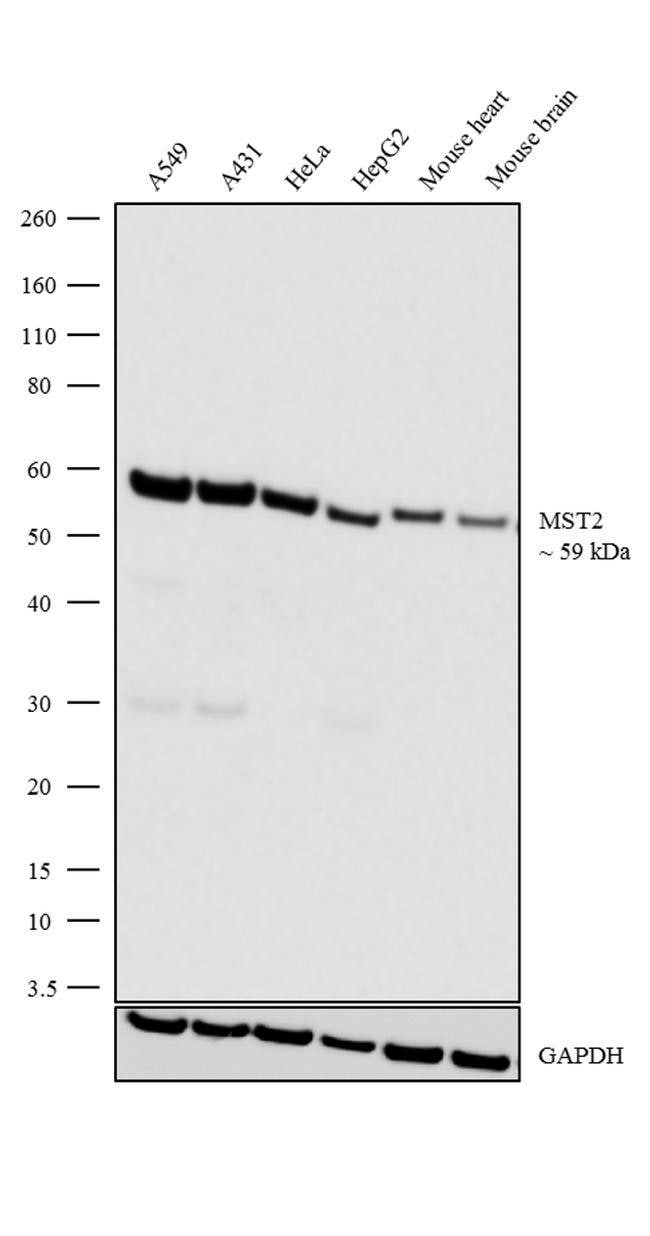
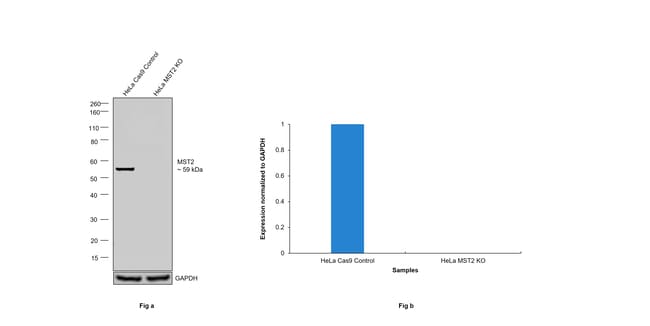
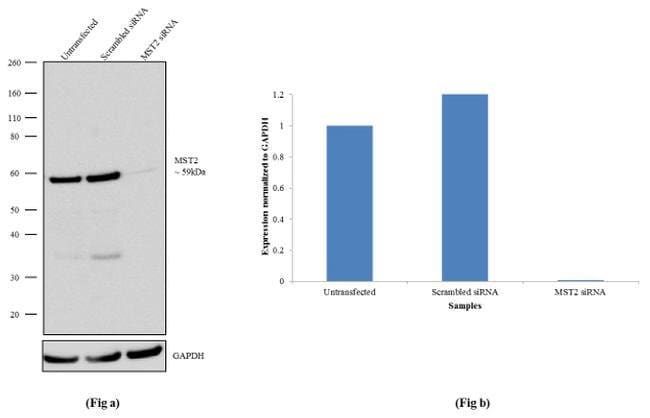
STK3 (MST2) is a STE kinase family member that acts upstream of the MAP kinase signaling pathways, and is known to be activated by the proapoptotic stimuli staurosporine and FAS ligand. STK3 is a stress-activated, pro-apoptotic kinase which, following caspase-cleavage, enters the nucleus and induces chromatin condensation followed by internucleosomal DNA fragmentation. It is a key component of the Hippo signaling pathway which plays a pivotal role in organ size control and tumor suppression by restricting proliferation and promoting apoptosis. The core of this pathway is composed of a kinase cascade wherein STK3/MST2 and STK4/MST1, in complex with its regulatory protein SAV1, phosphorylates and activates LATS1/2 in complex with its regulatory protein MOB1, which in turn phosphorylates and inactivates YAP1 oncoprotein and WWTR1/TAZ. Phosphorylation of YAP1 by LATS2 inhibits its translocation into the nucleus to regulate cellular genes important for cell proliferation, cell death, and cell migration. STK3/MST2 and STK4/MST1 are required to repress proliferation of mature hepatocytes, to prevent activation of facultative adult liver stem cells (oval cells), and to inhibit tumor formation.
TRUSTED_SUSTAINABILITY

Specifications

Antígeno MST2
Aplicaciones Western Blot
Clasificación Recombinant Monoclonal
Clon 19H19L39
Concentración 0.5 mg/mL
Conjugado Unconjugated
Formulación PBS with 0.09% sodium azide; pH 7.4
génica STK3
N.º de referencia del gen Q13188, Q9JI10
Alias de gen 0610042I06Rik; KB-1458E12.1; KRS1; Mammalian STE20-like protein kinase 2; mess1; MST; Mst2; MST-2; MST2/C; MST2/N; Mst3; protein kinase homolog; serine/threonine kinase 3; serine/threonine kinase 3 (STE20 homolog, yeast); serine/threonine kinase 3 (Ste20, yeast homolog); serine/threonine-protein kinase 3; Serine/threonine-protein kinase 3 20kDa subunit; Serine/threonine-protein kinase 3 36kDa subunit; Serine/threonine-protein kinase Krs-1; Ste20; STE20-like kinase MST2; STK3; wu:fc19e11; zgc:55383
Símbolos de los genes STK3
Especie del huésped Rabbit
Inmunógeno Protein Corresponding to human MST2 [aa436-aa484].
Método de purificación Protein A
Cantidad 100 μg
Estado normativo RUO
Primario o secundario Primary
ID de gen (Entrez) 56274, 6788
Especies diana Human, Mouse
Contenido y almacenamiento Store at 4°C short term. For long term storage, store at -20°C, avoiding freeze/thaw cycles.
Tipo de producto Antibody
Formulario Liquid
Isotype IgG
Show More Show Less
Product Title
Select an issue

By clicking Submit, you acknowledge that you may be contacted by Fisher Scientific in regards to the feedback you have provided in this form. We will not share your information for any other purposes. All contact information provided shall also be maintained in accordance with our Privacy Policy.