missing translation for 'onlineSavingsMsg'
Learn More

Invitrogen™ MELK Polyclonal Antibody
GREENER_CHOICE

Código de producto. 17751504
Change view
Click to view available options
Cantidad:
100 μL
Tamaño de la unidad:
100 microlitros
Código de producto. Cantidad unitSize
17751504 100 μL 100 microlitros
1 options
Este artículo no se puede devolver. Vea la política de devoluciones

Código de producto. 17751504

Marca: Invitrogen™ PA5120104

Por favor, para comprar este producto. ¿No tiene usuario web? Regístrese hoy mismo.

Este artículo no se puede devolver. Vea la política de devoluciones

Rabbit Polyclonal Antibody

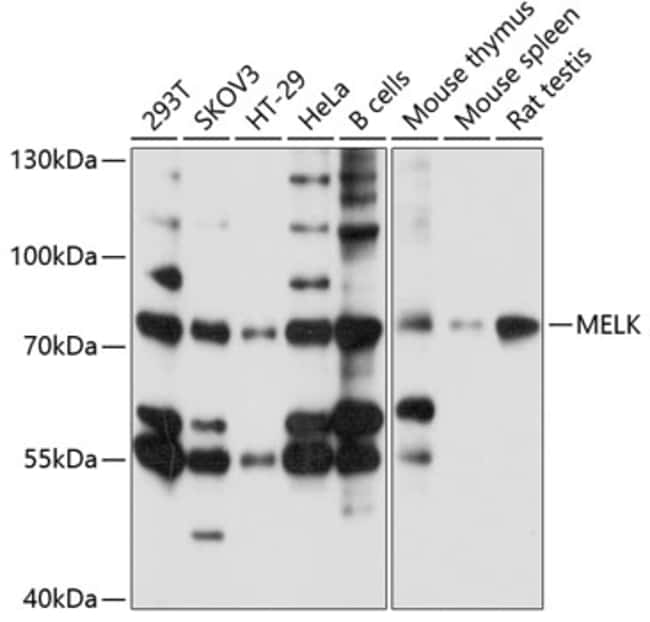
Positive test controls include: 293T, SKOV3, HT-29, HeLa, B cells, Mouse thymus, Mouse spleen, Rat testis. The target is usually found in the following locations: Cell membrane, Peripheral membrane protein. Immunogen sequence: LCRTPANKLK NKENVYTPKS AVKNEEYFMF PEPKTPVNKN QHKREILTTP NRYTTPSKAR NQCLKETPIK IPVNSTGTDK LMTGVISPER RCRSVELDLN QAHMEETPKR KGAKVFGSLE RGLDKVITVL TRSKRKGSAR DGPRRLKLHY NVTTTRLVNP DQLLNEIMSI LPKKHVDFVQ KGYTLKCQTQ SDFGKVTMQF ELEVCQLQKP DVVGIRRQRL KGDAWVYKRL VEDILSSCKV.

MELK is a serine/threonione kinase which is related to the AMPK family that has been linked to the cell cycle. MELK has also been shown to be overexpressed in cancer and has been identified has a potential target for cancer therapeutics. MELK has a broad substrate specificity; phosphorylates BCL2L14, CDC25B, MAP3K5/ASK1 and ZNF622. Acts as an activator of apoptosis by phosphorylating and activating MAP3K5/ASK1. Acts as a regulator of cell cycle, notably by mediating phosphorylation of CDC25B, promoting localization of CDC25B to the centrosome and the spindle poles during mitosis. Plays a key role in cell proliferation and carcinogenesis. Required for proliferation of embryonic and postnatal multipotent neural progenitors. Phosphorylates and inhibits BCL2L14, possibly leading to affect mammary carcinogenesis by mediating inhibition of the pro-apoptotic function of BCL2L14. Also involved in the inhibition of spliceosome assembly during mitosis by phosphorylating ZNF622, thereby contributing to its redirection to the nucleus. May also play a role in primitive hematopoiesis.
TRUSTED_SUSTAINABILITY

Especificaciones

Antígeno MELK
Aplicaciones ELISA, Western Blot
Clasificación Polyclonal
Concentración 1.83 mg/mL
Conjugado Unconjugated
Formulación PBS with 50% glycerol and 0.01% thimerosal; pH 7.3
génica MELK
N.º de referencia del gen Q14680, Q61846
Alias de gen AI327312; hMELK; HPK38; Kiaa0175; Maternal embryonic leucine zipper kinase; Melk; mKIAA0175; MPK38; OTTHUMP00000046113; pEg3 kinase; Pk38; Protein kinase Eg3; protein kinase PK38; RP11-8N6.1; Tyrosine-protein kinase MELK
Símbolos de los genes MELK
Especie del huésped Rabbit
Inmunógeno Recombinant fusion protein containing a sequence corresponding to amino acids 412-651 of human MELK (NP_055606.1).
Método de purificación Affinity Chromatography
Cantidad 100 μL
Estado normativo RUO
Primario o secundario Primary
ID de gen (Entrez) 17279, 362510, 9833
Especies diana Human, Mouse, Rat
Contenido y almacenamiento -20°C, Avoid Freeze/Thaw Cycles
Tipo de producto Antibody
Formulario Liquid
Isotype IgG
Mostrar más Mostrar menos
Título del producto
Seleccione un problema

Al hacer clic en Enviar, acepta que Fisher Scientific se ponga en contacto con usted en relación con los comentarios que ha proporcionado en este formulario. No compartiremos su información para ningún otro fin. Toda la información de contacto proporcionada se mantendrá de acuerdo con nuestra Política de Privacidad. Política de privacidad.