missing translation for 'onlineSavingsMsg'
Learn More
Learn More
Invitrogen™ GFP Polyclonal Antibody, HRP

Rabbit Polyclonal Antibody
Marca: Invitrogen™ A10260
Este artículo no se puede devolver.
Vea la política de devoluciones
Descripción
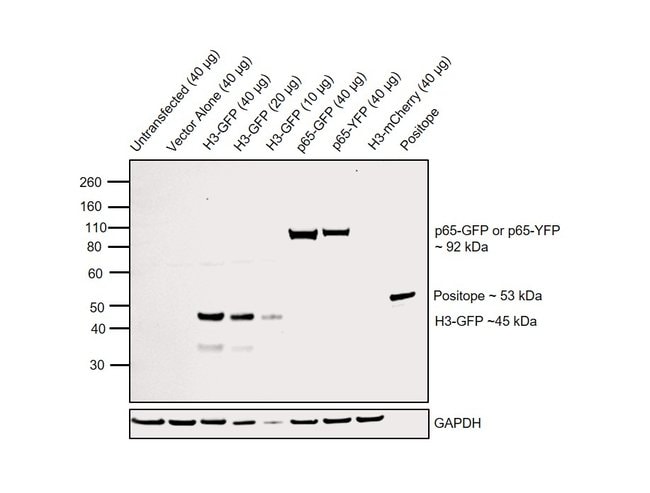
We offer the anti-GFP antibody HRP as purified rabbit IgG fraction and conjugated to horseradish peroxidase (HRP). At the time of preparation, the products are certified to be free of unconjugated dyes and are tested in a cytological experiment to ensure low nonspecific staining. This anti-GFP antibody HRP conjugate is suited for detection of native GFP, GFP variants, and most GFP-fusion proteins by western blot analysis and immunocytochemistry. For initial experiments, we recommend trying dilutions ranging from 1:200 to 1:2,000 for immunocytochemical applications and western blot analysis. It is a good practice to centrifuge the protein conjugate solutions briefly in a microcentrifuge before use; add only the supernatant to the experiment. This step eliminates any protein aggregates that may have formed during storage, thereby reducing nonspecific background staining. Storage and reconstitution: when stored desiccated at or below -20°C, the lyophilized powder is stable for at least one year. Reconstitute using 200 μL PBS, pH 7.2, to yield a 1 mg/mL stock solution containing 0.02% thimerosal. After reconstitution, store product at 4°C. For prolonged storage after reconstitution, add glycerol to a final concentration of 50% (v/v), aliquot, and store at or below -20°C. When stored properly, the solution is stable for approximately three months.
The jellyfish Aequorea victoria contains green fluorescent protein (GFP Tag) that emits light in the bioluminescence reaction of the animal. GFP has been used widely as a reporter protein for gene expression in eukaryotic and prokaryotic organisms, and as a protein tag in cell culture and in multicellular organisms. As a fusion tag, GFP can be used to localize proteins, to study their movement or to research the dynamics of the subcellular compartments where these proteins are targeted. GFP technology has revealed considerable new insights in the physiological activities of living cells. GFP is a 27 kDa monomeric protein, which autocatalytically forms a fluorescent pigment. The wild type protein absorbs blue light (maximally at 395nm) and emits green light (peak emission 508nm) in the absence of additional proteins, substrates, or co-factors. GFP fluorescence is stable, species independent and is suitable for a variety of applications. GFP has been used extensively as a fluorescent tag to monitor gene expressin and protein localization. Moreover, other applications for GFP include its use in assessing protein protein interactions in the yeast two hybrid system, and in measuring distances between proteins in fluorescence energy transfer (FRET) experiments.
Especificaciones
| GFP | |
| Polyclonal | |
| PBS with 0.02% thimerosal; pH 7.4 | |
| Rabbit | |
| Ion-exchange chromatography | |
| RUO | |
| Tag | |
| Antibody | |
| IgG |
| Immunohistochemistry, Western Blot | |
| HRP | |
| GFP; GFP tag; GFP2; green fluorescence; green fluorescent; Turbo eGFP | |
| The GFP was isolated directly from the jellyfish Aequorea victoria. | |
| 200 μg | |
| Primary | |
| -20°C | |
| Lyophilized | |
| Tag |
Corrección del contenido de un producto
Proporcione sus comentarios sobre el contenido del producto rellenando el siguiente formulario.
Título del producto
¿Detecta una oportunidad de mejora?Comparta una corrección de contenido