missing translation for 'onlineSavingsMsg'
Learn More
Learn More
PeproTech FGF4 Polyclonal Antibody, PeproTech®, Invitrogen™
Rabbit Polyclonal Antibody
Marca: PeproTech 500-P158-100UG
Este artículo no se puede devolver.
Vea la política de devoluciones
Descripción
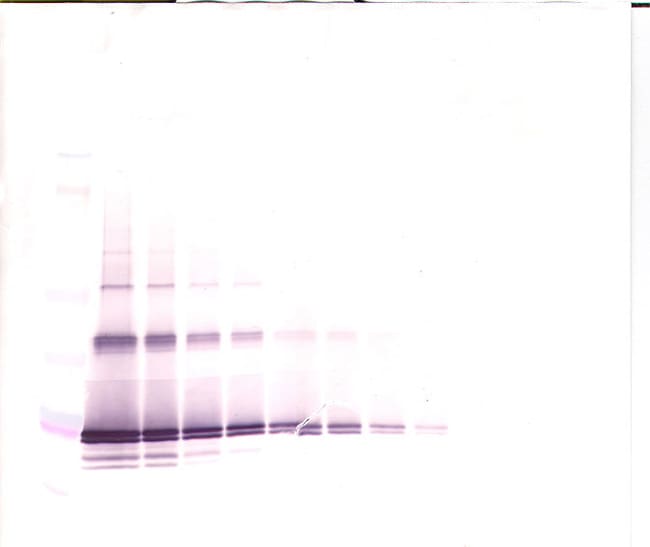
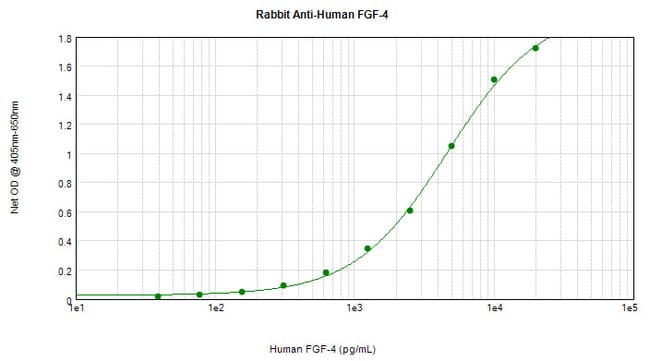
AA Sequence of recombinant protein: GRGGAAAPTA PNGTLEAELE RRWESLVALS LARLPVAAQP KEAAVQSGAG DYLLGIKRLR RLYCNVGIGF HLQALPDGRI GGAHADTRDS LLELSPVERG VVSIFGVASR FFVAMSSKGK LYGSPFFTDE CTFKEILLPN NYNAYESYKY PGMFIALSKN GKTKKGNRVS PTMKVTHFLP RL. Preparation: Produced from sera of rabbits immunized with highly pure Recombinant Human FGF-4. Anti-Human FGF-4-specific antibody was purified by affinity chromatography employing an immobilized Human FGF-4 matrix. Sandwich ELISA: To detect Human FGF-4 by sandwich ELISA (using 100 μL/well antibody solution) a concentration of 0.5-2.0 μg/mL of this antibody is required. This antigen affinity purified antibody, in conjunction with PeproTech Biotinylated Anti-Human FGF-4 (500-P158Bt) as a detection antibody, allows the detection of at least 0.2-0.4 ng/well of Recombinant Human FGF-4. Western Blot: To detect Human FGF-4 by Western Blot analysis this antibody can be used at a concentration of 0.1-0.2 μg/mL. Used in conjunction with compatible secondary reagents the detection limit for Recombinant Human FGF-4 is 1.5-3.0 ng/lane, under either reducing or non-reducing conditions.
Fibroblast growth factor 4 (FGF4) is a member of the fibroblast growth factor (FGF) family that possess broad mitogenic and cell survival activities and play key roles in growth and survival of stem cells during embryogenesis, tissue regeneration, and carcinogenesis. FGF4 was identified by its strong oncogenic transforming activity and is a potent angiogenic factor, expressed in several highly vascularized tumors and also in adult mouse testis, intestine, and brain. Studies on the mouse homolog suggests a function in bone morphogenesis and limb development through the sonic hedgehog (SHH) signaling pathway. Furthermore, FGF4 regulates neural progenitor cell proliferation and neuronal differentiation. Recent studies show a growth-promoting role for FGF4 in human embryonic stem cells and a putative feedback inhibition mechanism by a novel FGF4 splice isoform that may serve to promote differentiation at a later stages of development.
Especificaciones
| FGF4 | |
| Polyclonal | |
| Unconjugated | |
| Fgf4 | |
| FGF; FGF4; Fgf-4; Fgfk; Fibroblast growth factor; fibroblast growth factor 4; fibroblast growth factor 4 splice isoform; HBGF-4; heparin secretory transforming protein 1; heparin secretory-transforming protein 1; heparin-binding growth factor 1; heparin-binding growth factor 4; HST; Hst1; hst-1; HSTF1; HSTF-1; human stomach cancer, transforming factor from FGF-related oncogene; kaposi sarcoma oncogene; Kfgf; K-FGF; K-fibroblast growth factor; KS3; oncogene HST; transforming protein KS3 | |
| Rabbit | |
| Antigen affinity chromatography | |
| RUO | |
| 2249 | |
| -20°C | |
| Lyophilized |
| ELISA, Western Blot | |
| 0.1-1.0 mg/mL | |
| PBS with no preservative | |
| P08620 | |
| Fgf4 | |
| E.coli-derived Recombinant Human FGF-4. | |
| 100 μg | |
| Primary | |
| Human | |
| Antibody |
Corrección del contenido de un producto
Proporcione sus comentarios sobre el contenido del producto rellenando el siguiente formulario.
Título del producto
¿Detecta una oportunidad de mejora?Comparta una corrección de contenido