missing translation for 'onlineSavingsMsg'
Learn More
Learn More
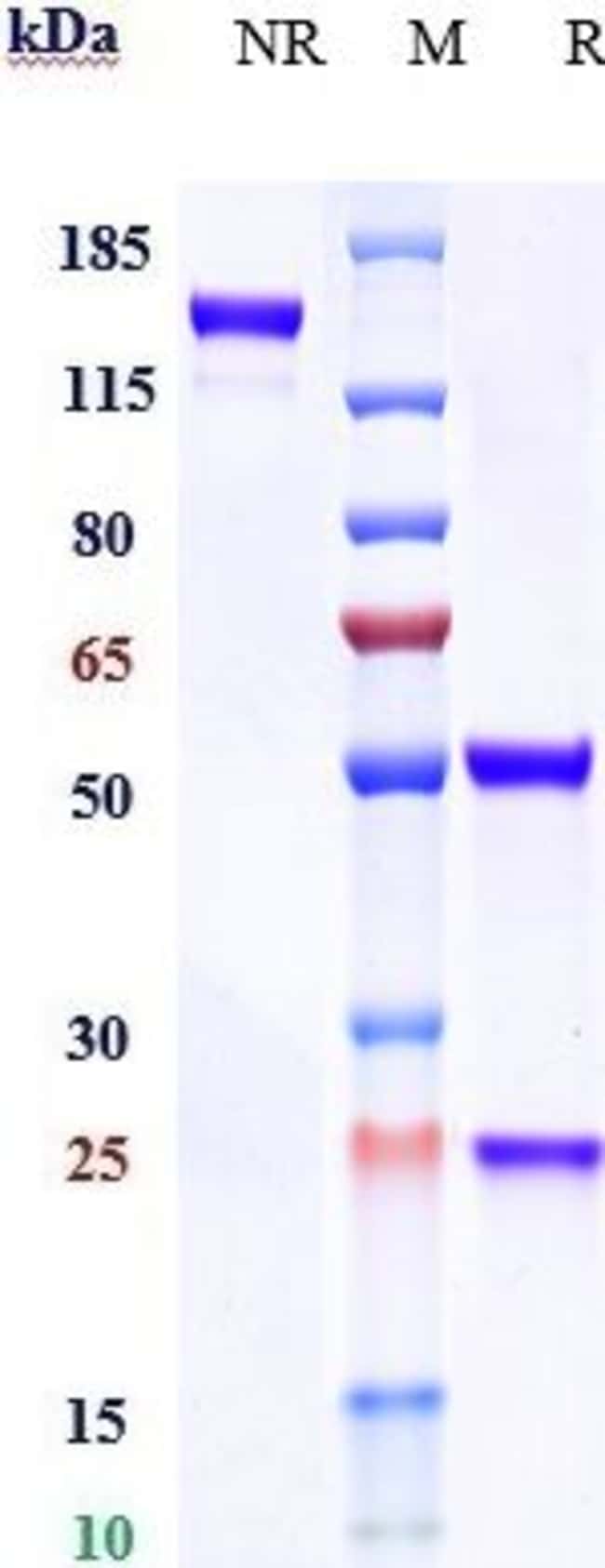
Invitrogen™ DC-SIGN (CD209) Biosimilar Recombinant Monoclonal Antibody

Recombinant Monoclonal Antibody
500.00€ - 1262.00€
Especificaciones
| Antígeno | DC-SIGN (CD209) Biosimilar |
|---|---|
| Concentración | 1 mg/mL |
| Contenido y almacenamiento | -20°C, Avoid Freeze/Thaw Cycles |
| Aplicaciones | ELISA, Flow Cytometry, Functional Assay, Surface Plasmon Resonance |
| Clasificación | Recombinant Monoclonal |
| Código de producto | Marca | Cantidad | Precio | Cantidad y disponibilidad | |||||
|---|---|---|---|---|---|---|---|---|---|
| Código de producto | Marca | Cantidad | Precio | Cantidad y disponibilidad | |||||
|
30282435
|
Invitrogen™
MA558545 |
100 μg |
500.00€
100 microgramos |
Por favor, inicie sesión para comprar este producto. ¿No tiene usuario web? Regístrese hoy mismo. | |||||
|
30282789
|
Invitrogen™
MA558546 |
1 mg |
1262.00€
1 miligramo |
Por favor, inicie sesión para comprar este producto. ¿No tiene usuario web? Regístrese hoy mismo. | |||||
Descripción
For reconstitution, add sterile, distilled water to achieve a final antibody concentration of 1 mg/mL. Gently shake to solubilize the protein completely. Do not vortex. Reconstituted products should be stored at -80 °. This antibody can also be cross referenced by the term INSERM patent anti-DC-SIGN.
This gene encodes a transmembrane receptor and is often referred to as DC-SIGN because of its expression on the surface of dendritic cells and macrophages. The encoded protein is involved in the innate immune system and recognizes numerous evolutionarily divergent pathogens ranging from parasites to viruses with a large impact on public health. The protein is organized into three distinct domains: an N-terminal transmembrane domain, a tandem-repeat neck domain and C-type lectin carbohydrate recognition domain. The extracellular region consisting of the C-type lectin and neck domains has a dual function as a pathogen recognition receptor and a cell adhesion receptor by binding carbohydrate ligands on the surface of microbes and endogenous cells. The neck region is important for homo-oligomerization which allows the receptor to bind multivalent ligands with high avidity. Variations in the number of 23 amino acid repeats in the neck domain of this protein are rare but have a significant impact on ligand binding ability. This gene is closely related in terms of both sequence and function to a neighboring gene (GeneID 10332; often referred to as L-SIGN). DC-SIGN and L-SIGN differ in their ligand-binding properties and distribution. Alternative splicing results in multiple variants.Especificaciones
| DC-SIGN (CD209) Biosimilar | |
| -20°C, Avoid Freeze/Thaw Cycles | |
| Recombinant Monoclonal | |
| Lyophilized | |
| IgG1 | |
| Human | |
| Primary | |
| Protein A |
| 1 mg/mL | |
| ELISA, Flow Cytometry, Functional Assay, Surface Plasmon Resonance | |
| Unconjugated | |
| Human | |
| RUO | |
| 25mM histidine with 8% sucrose, 0.01% Tween 80 and no preservative; pH 6.2 | |
| Antibody |
¿Detecta una oportunidad de mejora?Comparta una corrección de contenido
Corrección del contenido de un producto
Proporcione sus comentarios sobre el contenido del producto rellenando el siguiente formulario.
Título del producto