missing translation for 'onlineSavingsMsg'
Learn More
Learn More
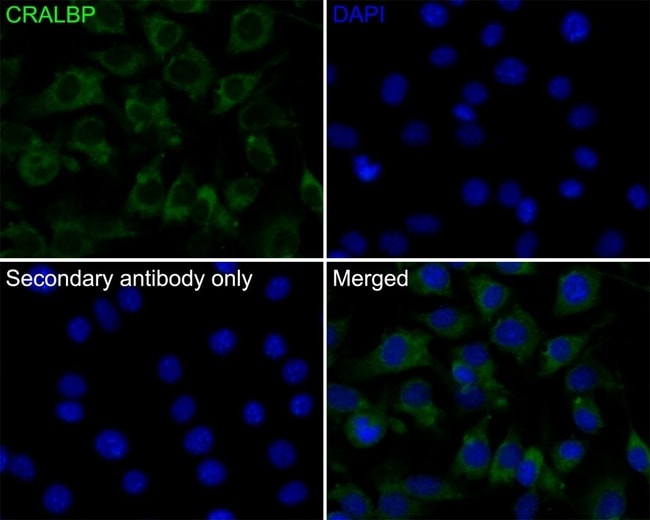
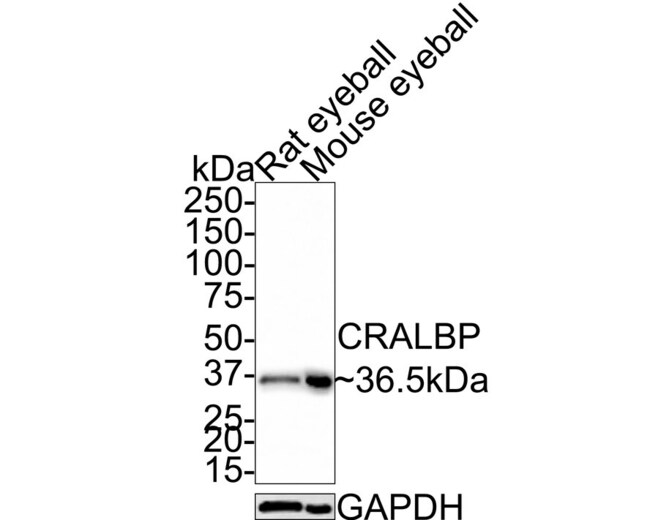
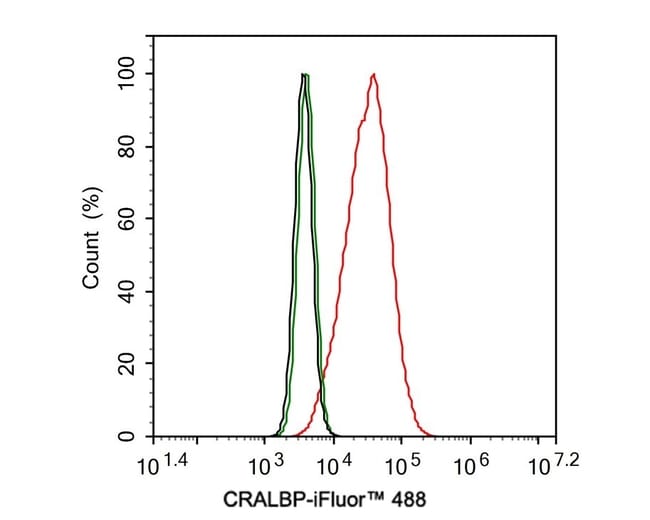
Invitrogen™ CRALBP Recombinant Rabbit Monoclonal Antibody (JE35-09)

Descripción
Positive control: Rat eyeball tissue lysate, mouse eyeball tissue lysate, B16F1. Predicted band size: 36.5 kDa Subcellular Location: Cytoplasm.
Cellular retinaldehyde-binding protein (CRALBP) plays an important role in the regeneration of 11-cis-retinal for use in rod visual pigments such as opsin and rhodopsin. Once 11-cis-retinal is photoisomerized in the rod outer segment, it is converted to all-trans-retinal and further modified into all-trans-retinol. All-trans-retinol then diffuses into the retinal pigment epithelium (RPE) to be converted back to 11-cis-retinol and further oxidized into 11-cis-retinal (both by CRALBP). Genetic mutations involving CRALBP's lack of function have been linked to visual disease such as bothnia dystrophy, retinitis punctata albescens, retina pigmentosa, and Newfoundland rod-cone dystrophy. The presence of CRALBP serves as a marker for RPE and Muller glial cells of the retina.

Especificaciones
Especificaciones
| Antígeno | CRALBP |
| Aplicaciones | Flow Cytometry, Western Blot, Immunocytochemistry |
| Clasificación | Recombinant Monoclonal |
| Clon | JE35-09 |
| Concentración | 1 mg/mL |
| Conjugado | Unconjugated |
| Formulación | TBS with 0.05% BSA, 40% glycerol and 0.05% sodium azide; pH 7.4 |
| génica | RLBP1 |
| N.º de referencia del gen | Q9Z275 |
| Alias de gen | 3110056M11Rik; cellular retinaldehyde-binding protein; cellular retinaldehyde-binding protein-1; CRALBP; retinaldehyde binding protein 1; retinaldehyde-binding protein 1; retinaldehyde-binding protein precursor; Rlbp1 |
| Mostrar más |
Título del producto
Al hacer clic en Enviar, acepta que Fisher Scientific se ponga en contacto con usted en relación con los comentarios que ha proporcionado en este formulario. No compartiremos su información para ningún otro fin. Toda la información de contacto proporcionada se mantendrá de acuerdo con nuestra Política de Privacidad. Política de privacidad.
¿Detecta una oportunidad de mejora?