missing translation for 'onlineSavingsMsg'
Learn More

Invitrogen™ CD27 Monoclonal Antibody (O323), NovaFluor™ Yellow 810, eBioscience™

Código de producto. 30276528
Change view
Click to view available options
Cantidad:
100 Tests
25 Tests
Tamaño de la unidad:
paquete de 100
paquete de 25
Código de producto. Cantidad unitSize
30276528 25 Tests paquete de 25
30276187 100 Tests paquete de 100
2 options
Este artículo no se puede devolver. Vea la política de devoluciones

Código de producto. 30276528

Marca: Invitrogen™ H012T02Y09A

Por favor, para comprar este producto. ¿No tiene usuario web? Regístrese hoy mismo.

Este artículo no se puede devolver. Vea la política de devoluciones

Mouse Monoclonal Antibody

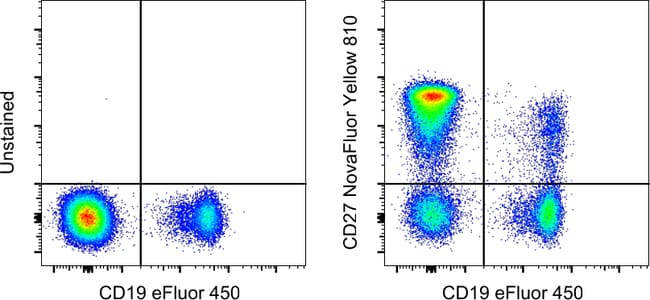
Description: The O323 monoclonal antibody reacts with human CD27, a lymphocyte-specific member of the TNFR superfamily. CD27 is expressed by a subset of thymocytes and virtually all mature T cells and is upregulated upon T-cell stimulation. CD27 binds to CD70, and through this interaction, plays an important role in T cell-B cell interaction. This product contains 1 vial of NovaFluor conjugate and 1 vial of CellBlox Plus Blocking Buffer. Applications Tested: The O323 antibody has been pre-titrated and tested by flow cytometric analysis of normal human peripheral blood cells. This can be used at 5 μL (0.4 μg) per test. A test is defined as the amount (μg) of antibody that will stain a cell sample in a final volume of 100 μL. Cell number should be determined empirically but can range from 10^5 to 10^8 cells/test. Master mixes. Whole Blood compatibility: When utilizing whole blood (as opposed to density-gradient-purified PBMC), we recommend lysing red blood cells in bulk prior to staining with NovaFluor conjugates.

CD27 is a 50 kDa member of the tumor necrosis factor (TNF) receptor superfamily that includes CD40 and CD30. The TNF superfamily members are known for the regulation of cell proliferation and death. In contrast to the expression of other TNFR/TNF family members, expression of CD27 and its ligand CD70 is predominantly confined to lymphocytes. High expression levels of CD27 appear to be dependent on proper ligation of antigen receptors. CD70 expression requires additional co-stimulatory and/or pro-inflammatory signals. CD27 is expressed as a disulfide-linked homodimer on mature thymocytes, peripheral blood T cells and a subpopulation of B cells. Activation of T cells via TCR-CD3 complex results in upregulation of CD27 expression on the plasma membrane as well as in the release of its soluble 28-32 kDa form, sCD27, detected in the plasma, urine or spinal fluid. Soluble CD27 is an important prognostic marker of acute and chronic B cell malignancies. RgpA, a cystein proteinase, although activating T cells through the protease-activated receptors (PARs), degradates CD27 and counteracts T cell activation mediated by CD27 and its ligand CD70. CD27-binding protein (SIVA), a proapoptotic protein, can bind to this receptor and is thought to play an important role in the apoptosis induced by this receptor. Diseases associated with CD27 dysfunction include Lymphoproliferative Syndrome 2 and Autosomal Recessive Lymphoproliferative Syndrome.
TRUSTED_SUSTAINABILITY

Especificaciones

Antígeno CD27
Aplicaciones Flow Cytometry
Clasificación Monoclonal
Clon O323
Concentración 0.4 μg/Test
Conjugado NovaFluor Yellow 810
Formulación PBS with BSA and 0.09% sodium azide; pH 7.2
génica CD27
N.º de referencia del gen P26842
Alias de gen CD antigen 27; CD27; CD27 antigen; CD27 molecule; CD27L receptor; LPFS2; S152; S152. LPFS2; sCD27; soluble CD27; T cell activation antigen S152; T14; T-cell activation antigen CD27; TNFRSF7; TNFSF7; Tp55; Tumor necrosis factor receptor superfamily member 7; tumor necrosis factor receptor superfamily, member 7
Símbolos de los genes CD27
Especie del huésped Mouse
Método de purificación Affinity chromatography
Cantidad 25 Tests
Estado normativo RUO
Primario o secundario Primary
ID de gen (Entrez) 939
Especies diana Human
Contenido y almacenamiento 4°C, store in dark, DO NOT FREEZE!
Tipo de producto Antibody
Formulario Liquid
Isotype IgG1 κ
Mostrar más Mostrar menos
Título del producto
Seleccione un problema

Al hacer clic en Enviar, acepta que Fisher Scientific se ponga en contacto con usted en relación con los comentarios que ha proporcionado en este formulario. No compartiremos su información para ningún otro fin. Toda la información de contacto proporcionada se mantendrá de acuerdo con nuestra Política de Privacidad. Política de privacidad.