missing translation for 'onlineSavingsMsg'
Learn More
Learn More
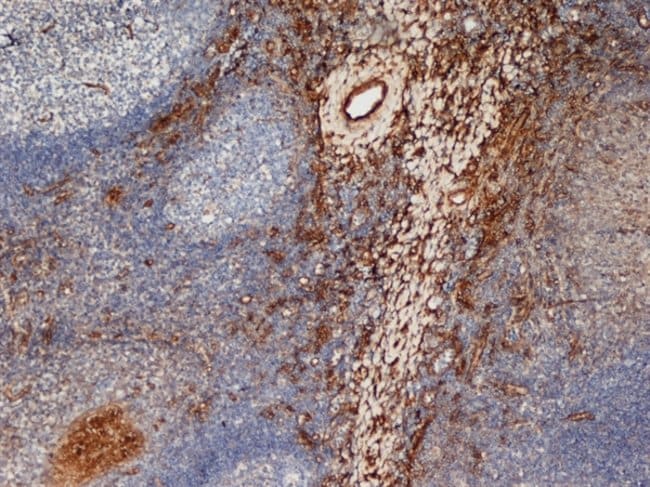
Invitrogen™ CD206 Monoclonal Antibody (7-450)

Descripción
A suggested positive control for immunohistochemical applications is human tonsil.
CD206 (MSR, Mannose receptor, MRC1) is a 175 kDa transmembrane protein belonging to the group of pattern recognition receptors. CD206 is predominantly expressed in tissue macrophages, dendritic cells, a subpopulation of endothelial cells and sperm cells. CD206 is thought to play a role in the innate and adaptive immune response. CD206 is also expressed on microglia and mato cells of the brain but not astrocytes or neurons. CD206 also mediate the recognition and uptake of a variety of macromolecules, including modified lipoproteins, advanced glycation end (AGEs) products and amyloid b-protein (Abeta). While the normal role of CD206 is associated with cell adhesion and host defense mechanisms, it also has been implicated in the development of atherosclerosis and Amyloid beta deposition in Alzheimer's disease (AD). CD206's gene encodes the class A macrophage scavenger receptors, which include three different types (1, 2, 3) generated by alternative splicing. The isoforms type 1 and type 2 are functional receptors and are able to mediate the endocytosis of modified low density lipoproteins (LDLs). The isoform type 3 does not internalize modified LDL (acetyl-LDL) despite having the domain shown to mediate this function in the types 1 and 2 isoforms. CD206 has an altered intracellular processing and is trapped within the endoplasmic reticulum, making it unable to perform endocytosis. The isoform type 3 can inhibit the function of isoforms type 1 and type 2 when co-expressed, indicating a dominant negative effect and suggesting a mechanism for regulation of scavenger receptor activity in macrophages. Other diseases associated with CD206 dysfunction include leprosy and Gaucher's Disease.

Especificaciones
Especificaciones
| Antígeno | CD206 |
| Aplicaciones | Immunohistochemistry (Frozen) |
| Clasificación | Monoclonal |
| Clon | 7-450 |
| Concentración | 1 mg/mL |
| Conjugado | Unconjugated |
| Formulación | PBS with 0.09% sodium azide |
| génica | Mrc1 |
| N.º de referencia del gen | P22897 |
| Alias de gen | AW259686; bA541I19.1; CD206; CELE_Y39A3CR.4; CLEC13D; CLEC13DL; C-type lectin domain family 13 member D; C-type lectin domain family 13 member D-like; ddp-1; hMR; Human mannose receptor; macrophage mannose receptor 1; Macrophage mannose receptor 1-like protein 1; mannose receptor, C type 1; mannose receptor, C type 1-like 1; Mitochondrial import inner membrane translocase subunit Tim8; MMR; MR; MRC1; MRC1L1; tim-8; Y39A3CR.4 |
| Mostrar más |
Título del producto
Al hacer clic en Enviar, acepta que Fisher Scientific se ponga en contacto con usted en relación con los comentarios que ha proporcionado en este formulario. No compartiremos su información para ningún otro fin. Toda la información de contacto proporcionada se mantendrá de acuerdo con nuestra Política de Privacidad. Política de privacidad.
¿Detecta una oportunidad de mejora?