Learn More
PeproTech CCL4 Polyclonal Antibody, Biotin, PeproTech®, Invitrogen™

Descripción
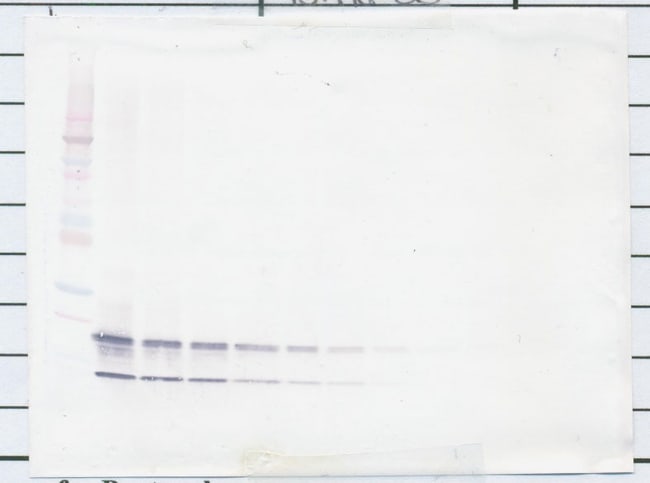
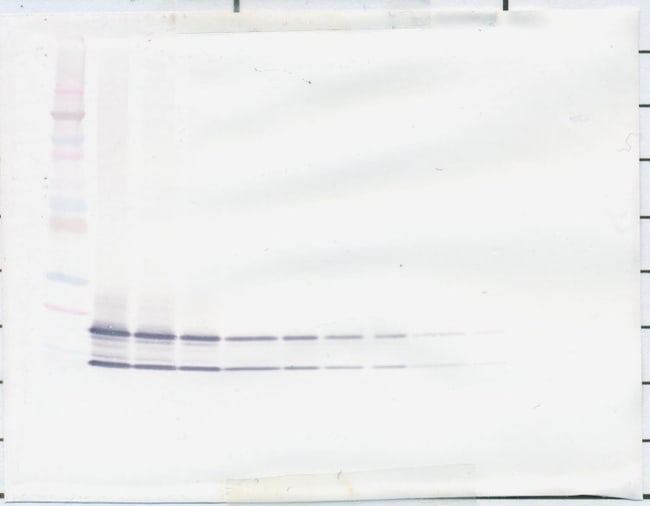
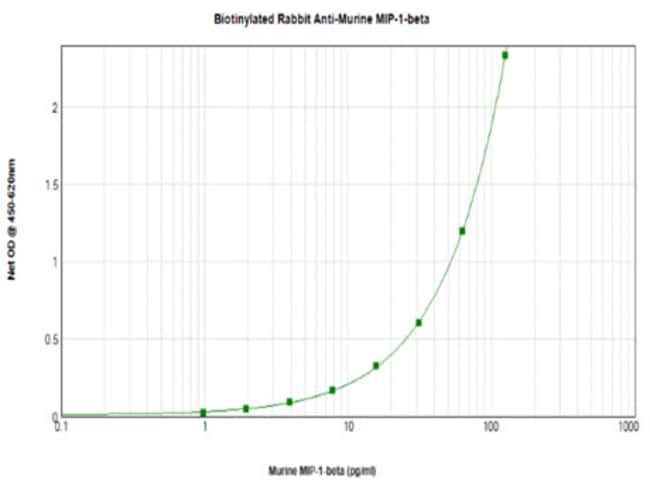
AA Sequence of recombinant protein: APMGSDPPTS CCFSYTSRQL HRSFVMDYYE TSSLCSKPAV VFLTKRGRQI CANPSEPWVT EYMSDLELN. Preparation: Produced from sera of rabbits immunized with highly pure Recombinant Murine MIP-1beta (CCL4). Anti-Murine MIP-1beta (CCL4)-specific antibody was purified by affinity chromatography and then biotinylated. Sandwich ELISA: To detect Murine MIP-1beta by sandwich ELISA (using 100 μL/well antibody solution) a concentration of 0.25-1.0 μg/mL of this antibody is required. This biotinylated polyclonal antibody, in conjunction with PeproTech Polyclonal Anti-Murine MIP-1beta (500-P213) as a capture antibody, allows the detection of at least 0.2-0.4 ng/well of Recombinant Murine MIP-1beta. Western Blot: To detect Murine MIP-1beta by Western Blot analysis this antibody can be used at a concentration of 0.1-0.2 μg/mL. When used in conjunction with compatible secondary reagents, the detection limit for Recombinant Murine MIP-1beta is 1.5-3.0 ng/lane, under either reducing or non-reducing conditions. 500-P213BT-1MG will be provided as 2 x 500 μg

Especificaciones
Especificaciones
| Antígeno | CCL4 |
| Aplicaciones | ELISA, Western Blot |
| Clasificación | Polyclonal |
| Concentración | 0.1-1.0 mg/mL |
| Conjugado | Biotin |
| Formulación | PBS with no preservative |
| génica | CCL4 |
| N.º de referencia del gen | P14097 |
| Alias de gen | ACT2; ACT-2; AT744.1; CC chemokine ligand 4; C-C motif chemokine 4; C-C motif chemokine ligand 4; Ccl4; chemokine (C-C motif) ligand 4; G-26; G-26 T-lymphocyte-secreted protein; HC21; immune activation gene 2; immune activation gene-2; immune activation protein 2; LAG1; LAG-1; Lymphocyte activation gene 1 protein; macrophage inflammatory protein 1-beta; macrophage inflammatory protein-1 beta; MGC104418; MGC126025; MGC126026; MIP-1 beta; MIP1b; MIP-1B; Mip1-b; MIP1B1; MIP1beta; MIP-1BETA; MIP-1-beta; MIP1-beta; MIP-1-beta(1-69); MIP-1-beta(3-69); PAT 744; Protein H400; putative MIP-1beta protein; RP23-320E6.8; SCY4A; SCYA2; Scya4; secreted protein G-26; SIS-gamma; small inducible cytokine A4; small inducible cytokine A4 (homologous to mouse Mip-1b); small-inducible cytokine A4; T-cell activation protein 2 |
| Símbolos de los genes | CCL4 |
| Mostrar más |
Al hacer clic en Enviar, acepta que Fisher Scientific se ponga en contacto con usted en relación con los comentarios que ha proporcionado en este formulario. No compartiremos su información para ningún otro fin. Toda la información de contacto proporcionada se mantendrá de acuerdo con nuestra Política de Privacidad. Política de privacidad.