Learn More
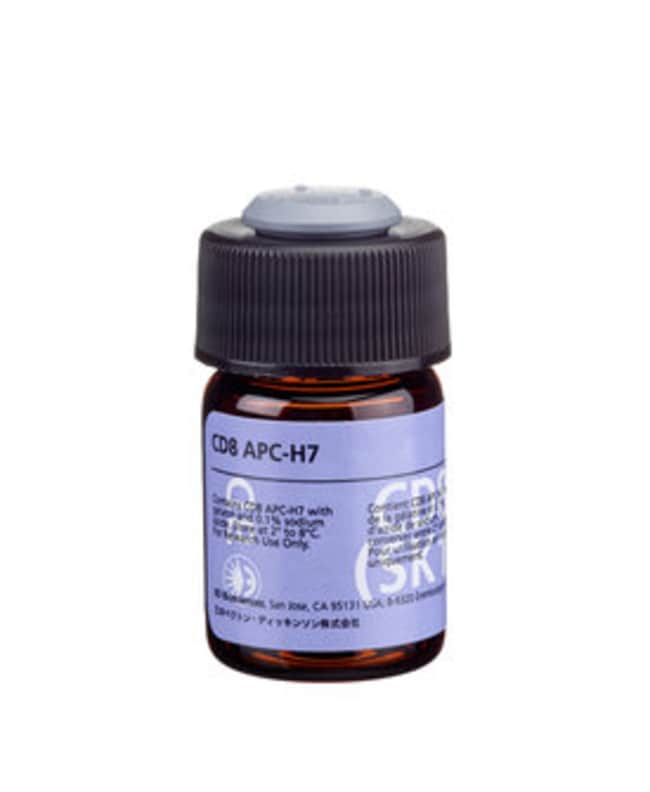
CD8 Mouse anti-Human, APC-H7, Clone: SK1, BD
Description
CD8 clone SK1 is derived from hybridization of mouse NS-1 myeloma cells with spleen cells from BALB/c mice immunized with human peripheral blood T lymphocytes.
The CD8 antibody recognizes the 32-kilodalton (kDa) α-subunit of a disulfide-linked bimolecular complex. The majority of peripheral blood CD8+ T lymphocytes express an α/β heterodimer (Mr 32, 30 kDa), while CD8
The CD8 antibody recognizes the 32-kilodalton (kDa) α-subunit of a disulfide-linked bimolecular complex. The majority of peripheral blood CD8+ T lymphocytes express an α/β heterodimer (Mr 32, 30 kDa), while CD8+CD16+natural killer (NK) lymphocytes and CD8+ T-cell receptor (TCR)-γ/δ+ T lymphocytes express an α/α homodimer (Mr 30 kDa). CD8+TCR-α/β+ T lymphocytes can express either an α/α homodimer or α/β heterodimer. The CD8 antigenic determinant binds to class I major histocompatibility (MHC) molecules, resulting in increased adhesion between the CD8+ T lymphocytes and target cells. Binding of the CD8 antigen to class I MHC molecules enhances the activation of resting T lymphocytes. The CD8 antigen is coupled to a protein tyrosine kinase, p56lck. The CD8:p56lck complex can play a role in T-lymphocyte activation through mediation of the interactions between the CD8 antigen and the CD3/TCR complex.

Specifications
Specifications
| Antígeno | CD8 |
| Aplicaciones | Flow Cytometry |
| Clasificación | Monoclonal |
| Clon | SK1 |
| Concentración | 50μg/mL |
| Conjugado | APC-H7 |
| Formulación | Phosphate buffered saline with gelatin and 0.1% sodium azide. |
| Especie del huésped | Mouse |
| Inmunógeno | Human Peripheral Blood T Cells |
| Método de purificación | Affinity Purified |
| Show More |
By clicking Submit, you acknowledge that you may be contacted by Fisher Scientific in regards to the feedback you have provided in this form. We will not share your information for any other purposes. All contact information provided shall also be maintained in accordance with our Privacy Policy.