missing translation for 'onlineSavingsMsg'
Learn More
Learn More
Invitrogen™ SCNN1D Polyclonal Antibody

Descripción
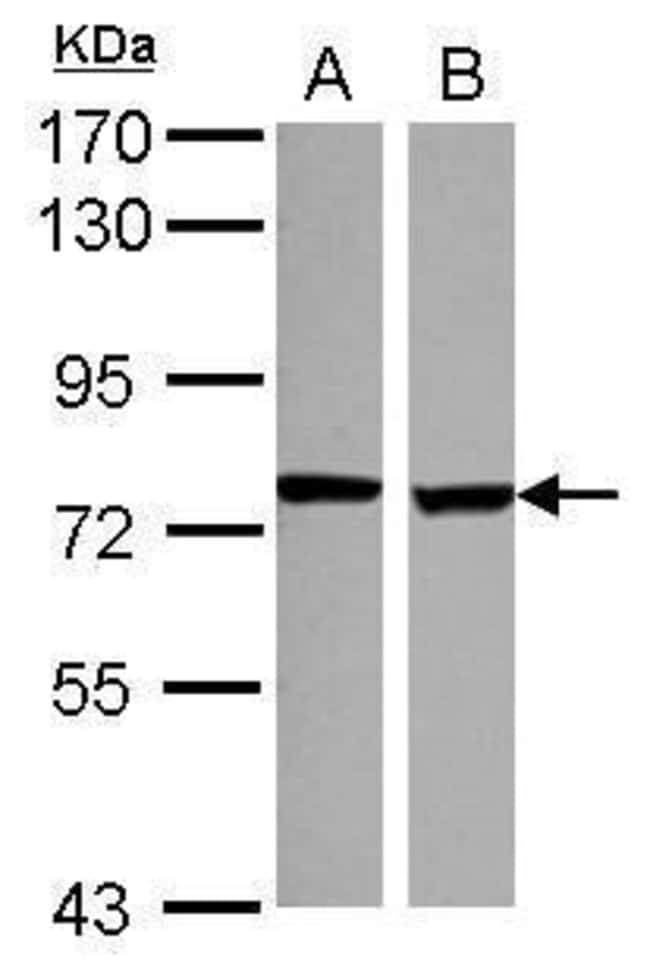
Recommended positive controls: NT2D1, IMR32, U87-MG, MCF-7. Predicted reactivity: Chimpanzee (98%). Store product as a concentrated solution. Centrifuge briefly prior to opening the vial.
SNX6 interacts with members of the transforming growth factor-beta family of receptor serine-threonine kinases. These receptors belong to two classes: type II receptors that bind ligand, and type I receptors that are subsequently recruited to transduce the signal. Of the type II receptors, SNX6 was found to interact strongly with ActRIIB and more moderately with wild type and kinase-defective mutants of TbetaRII. Of the type I receptors, SNX6 was found to interact only with inactivated TbetaRI. SNXs 1-4 also interacted with the transforming growth factor-beta receptor family, showing different receptor preferences. Conversely, SNX6 behaved similarly to the other SNX proteins in its interactions with receptor tyrosine kinases. Strong heteromeric interactions were also seen among SNX1, -2, -4, and -6, suggesting the formation in vivo of oligomeric complexes. These findings are the first evidence for the association of the SNX family of molecules with receptor serine-threonine kinases.

Especificaciones
Especificaciones
| Antígeno | SCNN1D |
| Aplicaciones | Western Blot |
| Clasificación | Polyclonal |
| Concentración | 1 mg/mL |
| Conjugado | Unconjugated |
| Formulación | PBS with 1% BSA, 20% glycerol and 0.01% thimerosal; pH 7 |
| génica | SCNN1D |
| N.º de referencia del gen | P51172 |
| Alias de gen | Amiloride-sensitive sodium channel subunit delta; delta-ENaC; Delta-NaCH; DNACH; ENaCd; ENaCdelta; epithelial Na(+) channel subunit delta; MGC149710; Nonvoltage-gated sodium channel 1 subunit delta; SCNED; SCNN1D; sodium channel epithelial 1 delta subunit; sodium channel, non voltage gated 1 delta subunit; sodium channel, nonvoltage-gated 1, delta; sodium channel, non-voltage-gated 1, delta subunit; sodium channel, voltage-gated, type I, delta polypeptide |
| Símbolos de los genes | SCNN1D |
| Mostrar más |
Título del producto
Al hacer clic en Enviar, acepta que Fisher Scientific se ponga en contacto con usted en relación con los comentarios que ha proporcionado en este formulario. No compartiremos su información para ningún otro fin. Toda la información de contacto proporcionada se mantendrá de acuerdo con nuestra Política de Privacidad. Política de privacidad.
¿Detecta una oportunidad de mejora?