missing translation for 'onlineSavingsMsg'
Learn More
Learn More

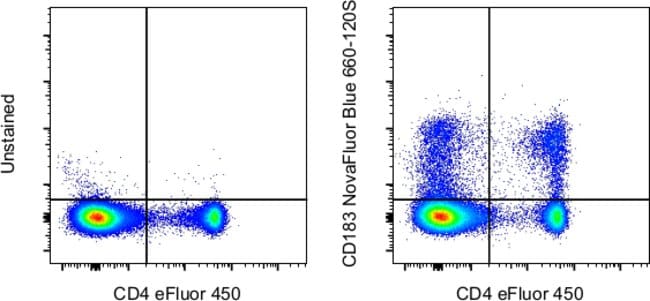
CD183 (CXCR3) Monoclonal Antibody (CXCR3-173), NovaFluor™ Blue 660-120S, eBioscience™, Invitrogen™
Descripción
This gene encodes a G protein-coupled receptor with selectivity for three chemokines, termed IP10 (interferon-g-inducible 10 kDa protein), Mig (monokine induced by interferon-g) and I-TAC (interferon-inducible T cell a-chemoattractant). IP10, Mig and I-TAC belong to the structural subfamily of CXC chemokines, in which a single amino acid residue separates the first two of four highly conserved Cys residues. Binding of chemokines to this protein induces cellular responses that are involved in leukocyte traffic, most notably integrin activation, cytoskeletal changes and chemotactic migration. Inhibition by Bordetella pertussis toxin suggests that heterotrimeric G protein of the Gi-subclass couple to this protein. Signal transduction has not been further analyzed but may include the same enzymes that were identified in the signaling cascade induced by other chemokine receptors. As a consequence of chemokine-induced cellular desensitization (phosphorylation-dependent receptor internalization), cellular responses are typically rapid and short in duration. Cellular responsiveness is restored after dephosphorylation of intracellular receptors and subsequent recycling to the cell surface. This gene is prominently expressed in in vitro cultured effector/memory T cells, and in T cells present in many types of inflamed tissues. In addition, IP10, Mig and I-TAC are commonly produced by local cells in inflammatory lesion, suggesting that this gene and its chemokines participate in the recruitment of inflammatory cells. Therefore, this protein is a target for the development of small molecular weight antagonists, which may be used in the treatment of diverse inflammatory diseases. Multiple transcript variants encoding different isoforms have been found for this gene.

Especificaciones
Especificaciones
| Antígeno | CD183 (CXCR3) |
| Aplicaciones | Flow Cytometry |
| Clasificación | Monoclonal |
| Clon | CXCR3-173 |
| Concentración | 0.1 mg/mL |
| Conjugado | NovaFluor Blue 660-120S |
| Formulación | PBS with 0.09% sodium azide; pH 7.2 |
| génica | CXCR3 |
| N.º de referencia del gen | O88410 |
| Alias de gen | an; C Cmotif chemokine; C X C motif chemokine; CC motif chemokine; CCmotif chemokine; CD182; CD183; chemokine (C-X-C motif) receptor 3; chemokine receptor 3; CKR-L2; Cmkar3; CXC; C-X-C chemokine receptor type 3; CXC motif chemokine; C-X-C motif chemokine receptor 3; Cxcr3; CXC-R3; CXCR-3; G protein-coupled receptor 9; GPR9; Interferon-inducible protein 10 receptor; IP10; IP10 receptor; IP-10 receptor; IP10-R; Mig receptor; MigR; Mig-R |
| Mostrar más |
Título del producto
Al hacer clic en Enviar, acepta que Fisher Scientific se ponga en contacto con usted en relación con los comentarios que ha proporcionado en este formulario. No compartiremos su información para ningún otro fin. Toda la información de contacto proporcionada se mantendrá de acuerdo con nuestra Política de Privacidad. Política de privacidad.
¿Detecta una oportunidad de mejora?